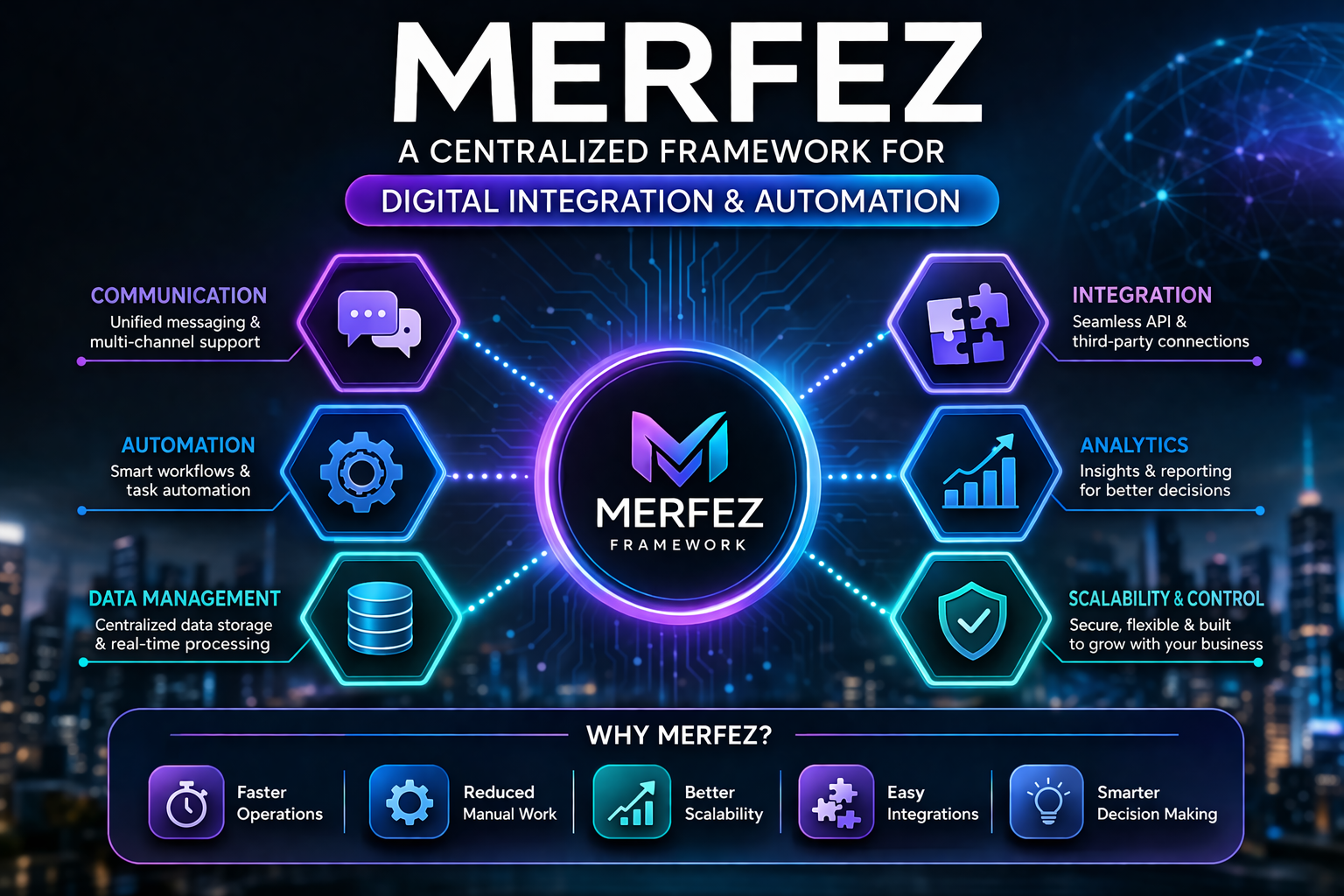
As businesses come to rely more on automation, connected platforms, and real-time communication processes that link everything together have become essential. Merfez is becoming recognized as a rapidly globalizing decentralized framework for dealing with your digital operations and connecting communication channels, tying together different System processes into one manageable structure.
In use cases ranging from messaging environments to workflow automation using platform operations or integrated software ecosystems, the Merfez framework is indicative of how we modernize efficiency and scalability while counteracting fragmentation in an age of digital expansion. The guide followed describe what Merfez stands for, how it works and where it is used, and the reason why it will gain more usage in 2026.
Merfez is an information-oriented computerized structure or system that uses to integrate various functional, communicative, and data transformation aspects into one environment. Simply put, it is the backbone that enables multiple features in a business or platform to be executed from one foundation.
Merfez prevents fragmentation of communicating tools, automation modules, analytics and system operations. This helps simplify control over workflows, increase visibility and scale systems without adding unnecessary complexity.
The Merfez framework works by integrating different modules into a unified system.
This desire is one of the most compelling reasons that the Merfez framework could rank well as a topic — people want more than a definition. They also want to dig into the architecture that enables it.
A common Merfez architecture might have these components:
| Layer | Role |
|---|---|
| Core Engine | Controls rules, workflows, and system behavior |
| Communication Module | Handles messages and interactions |
| Data Layer | Stores and retrieves structured information |
| API Layer | Connects internal and external systems |
| Analytics Layer | Measures performance and generates insights |
| Admin Layer | Allows teams to manage and monitor operations |
This architecture helps platforms stay organized, scalable, and efficient.
All operations are managed from one place
Reduces manual work through automation
Can handle growing data and users
Connects with multiple tools and platforms
Handles data instantly for faster decisions.
Also Read: Klar Partners Ltd / Oleter Group Platform Strategy
Modern communication systems require:
👉 Merfez enables:
This makes it highly relevant in customer engagement tools and digital platforms.
Also Read: Complete guide About Messengal Platform
| Benefit | Impact |
|---|---|
| Efficiency | Faster operations |
| Centralization | Better control |
| Automation | Reduced workload |
| Scalability | Business growth support |
| Integration | Seamless workflows |
| Feature | Merfez | Traditional Systems |
|---|---|---|
| Structure | Centralized | Fragmented |
| Automation | High | Low |
| Integration | Easy | Difficult |
| Speed | Fast | Slow |
👉 Merfez clearly provides modern system advantages.
👉 Merfez solves all these challenges by:
Imagine a business using:
Without Merfez → All systems separate
With Merfez →
👉 Everything connected in one system.
This is a common question.
In most cases, we can consider that Merfez is not limited to a single tool but instead a core system structure (framework). It specifies the arrangements, interconnections, and management of digital elements.
So while one platform may create software surrounding Merfez, the general idea is broader than just a single application.
Merfez is becoming a significant tool for current digital systems, allowing companies to bring all their communications to one place, to make processes happen on their own, and to work with their information in a more effective way. As technology advances, systems that work together as Merfez does will become even more essential.
Looking ahead to 2026, selecting a framework such as Merfez isn’t simply changing the technology you have; it’s a carefully planned decision to allow for expansion, to improve how things are done, and to ensure progress in the future. Companies using these types of systems will be able to do better than their rivals in the digital world, which is getting more competitive all the time.
Q1. What is Merfez?
Merfez is a centralized framework used to manage communication, data, and workflows in a unified system.
Q2. Where is Merfez used?
It is used in messaging platforms, SaaS tools, automation systems, and business operations.
Q3. Is Merfez a software or a framework?
It is generally considered a framework or system structure rather than a single software.
Q4. Why is Merfez important?
Because it simplifies operations, improves efficiency, and enables automation.